Special Reports
Canada and Europe’s Alliance Without a Rulebook
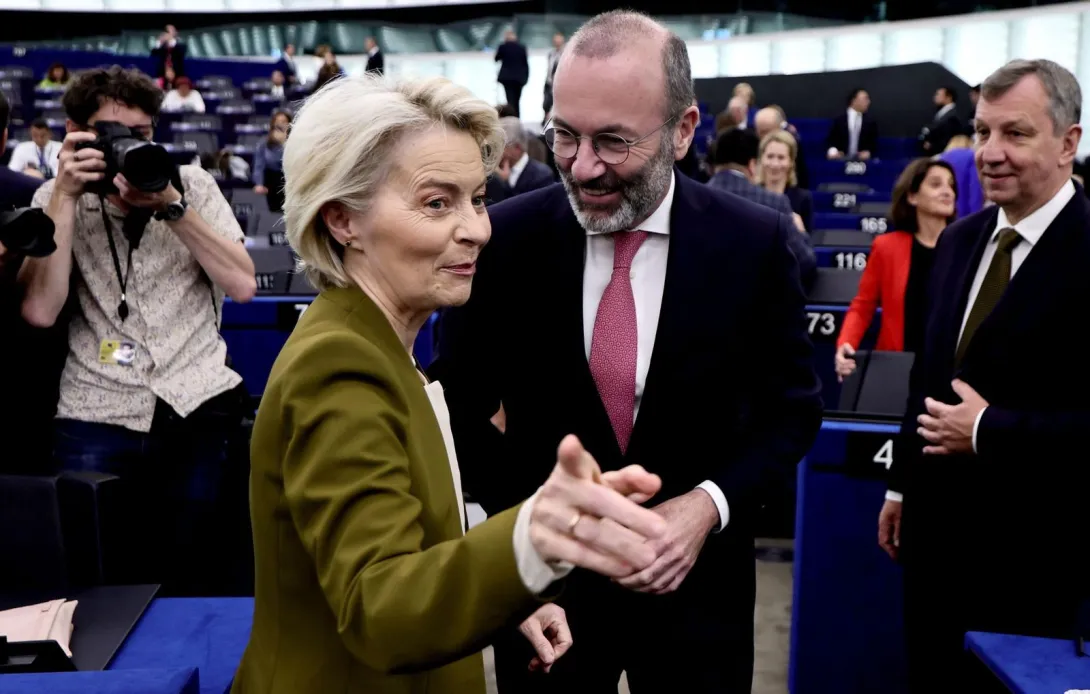
A proposal without precedent now faces its harder test: defining rights, obligations, funding and delivery before political momentum fades.
Canada cannot become an EU member under the existing accession rule. It may instead become the test case for a new form of transatlantic association—if Europe and Canada can turn an undefined status into law, money and working institutions.
Trump’s coercive diplomacy has accelerated a pre-existing EU–Canada convergence into an attempt to create a new category of transatlantic association. The architecture is real, but its legal form and capacity to reduce dependence on the United States remain unproven.
- The European Union has proposed making Canada its first “associate member,” but no such status presently exists in EU law. Full membership under the current treaty route is limited to European states. An association agreement could provide a flexible alternative, yet the Commission has not said what rights Canada would receive, what obligations it would accept or whether the project will be one treaty or a collection of sectoral arrangements.
- The rapprochement is real and predates the latest conflict with Washington. CETA has applied provisionally since 2017; Canada joined part of Horizon Europe in 2024; an EU–Canada security and defence partnership followed in 2025; and Canada became the first non-European participant in SAFE procurement in 2026. Donald Trump did not create this infrastructure, but tariffs, territorial provocations and uncertainty about US commitments have sharply increased its political value.
- The proposed capabilities bargain is unusually specific. Canada is offering energy, minerals, defence production, Arctic geography, space expertise, artificial intelligence and financial capacity; Europe offers market scale, advanced manufacturing, processing, research networks and procurement demand. Defence and research already have institutional channels. Integrated mineral value chains are developing. Large-scale LNG, shared sovereign computing, mobility rights and a common financial-services market remain substantially aspirational.
- The principal constraint is not a lack of diplomatic enthusiasm but asymmetric dependence. In 2025, 71.7% of Canadian merchandise exports still went to the United States, compared with 53% of services exports. Ten EU states have not ratified CETA. Europe still relies heavily on NATO and US capabilities. The October 29–30 summit in Montreal will matter only if it supplies a legal route, governing machinery, money and initial deliverables.
The Status That Does Not Yet Exist
In Strasbourg on September 16, Ursula von der Leyen went beyond the recurring conceit of Canada as an honorary European country. With Prime Minister Mark Carney watching from the European Parliament, the European Commission president proposed opening the door for Canada to become the European Union’s first “associate member.” The phrase conveyed more than friendship and less than accession. Its force came from suggesting a place for Canada within the European project while leaving the nature of that place undefined.
Full EU membership is not the proposition. Article 49 of the Treaty on European Union allows any European state meeting the Union’s values and conditions to apply. Canada does not fit that route under the existing treaty framework, a distinction the Commission itself emphasised two days after von der Leyen’s speech. The proposal is therefore not a Canadian path to becoming the 28th member. Nor does it imply representation in the European Council, voting rights in the Council, seats in Parliament or automatic participation in the single market.
The Commission’s September 18 briefing exposed the distance between the political announcement and an institutional settlement. Officials described associate membership as an ambitious idea whose parameters would be explored with Canada and EU governments. They did not define whether it would include mobility, selected single-market freedoms, contributions to the EU budget, regulatory alignment or jurisdiction for disputes. They also did not identify a settled legal instrument or say whether treaty change would be necessary.
That uncertainty does not make the proposal empty. Naming a new status can create a negotiating objective around which existing agreements are reorganised. But the verified finding is narrower than the rhetoric: Europe and Canada have agreed that their relationship should reach a level not captured by CETA alone; they have not agreed what that level is. The consequential story is an attempt to construct a new category of transatlantic association, not a disguised enlargement of the EU.
The breakthrough is political; the rulebook is still unwritten.
| Institutional definition (%) | |
|---|---|
| Full EU membership | 100 |
| Established association agreements | 70 |
| Sectoral partnerships | 35 |
| Canada associate-member proposal | 5 |
Nine Months to Strasbourg, Four Days to the Arctic
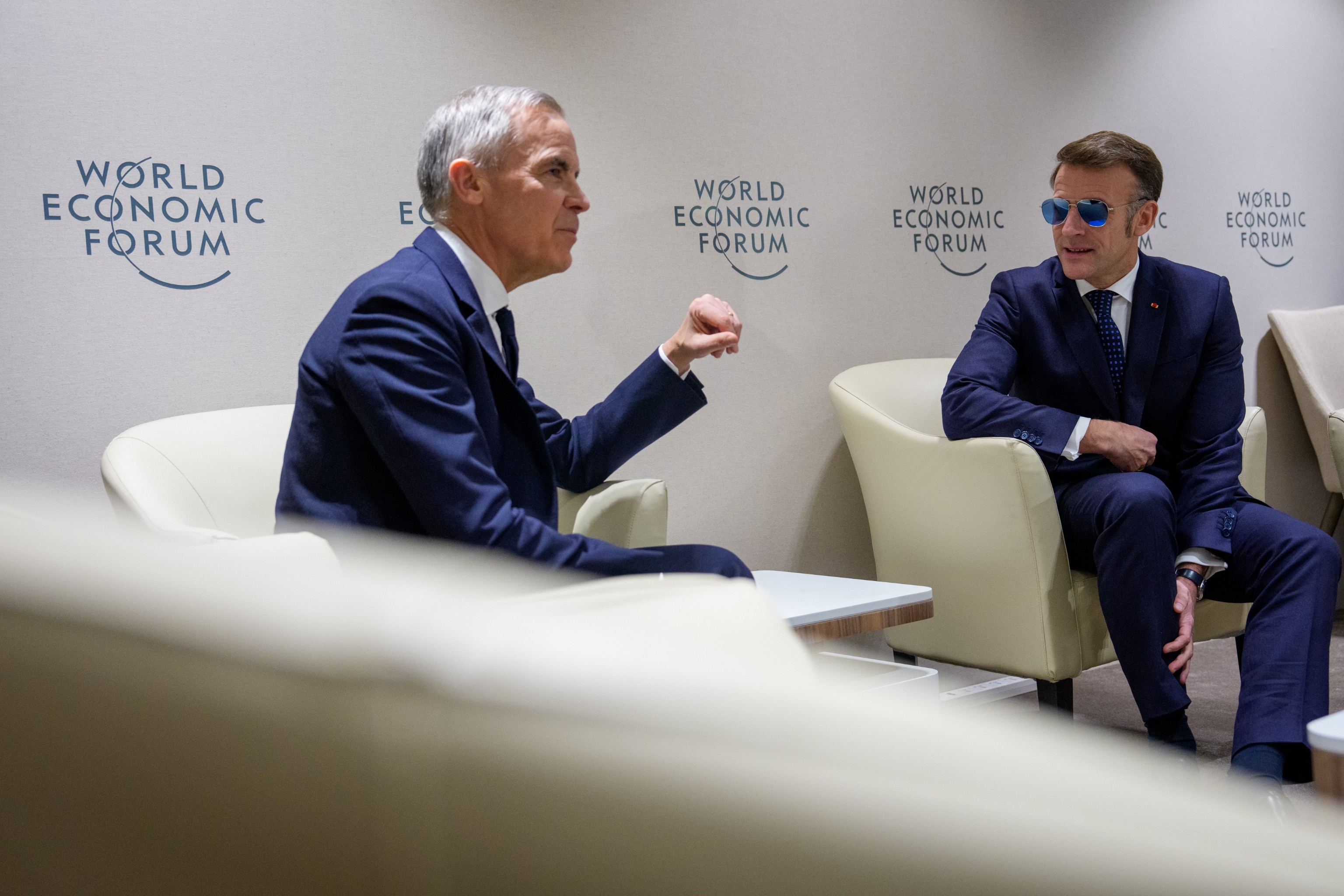
The political sequence ran across nine calendar months, from Carney’s January 20 address in Davos to the September week in which Europe and Canada compressed trade conflict, parliamentary diplomacy and Arctic security into a single narrative. Davos supplied the doctrine. Carney argued that middle powers had to cooperate issue by issue, reduce the leverage that enabled coercion and stop relying on an international order that no longer functioned as advertised. The message was broader than the United States, but it supplied the intellectual frame for Canada’s European turn.
The next stage was material pressure. On August 21, after negotiations with Washington broke down, Carney said the United States would impose tariffs of up to 50% on roughly C$28 billion of Canadian goods and promised a dollar-for-dollar response. Canada’s detailed measures took effect on September 8, covering C$27.6 billion of US imports at rates of 15%, 25% or 50%, depending on the corresponding American measure. The lists concentrated on products including steel and aluminium, dairy, appliances, agricultural equipment, pulp and paper, plastics and electronics. A remission process remained available for exceptional cases.
Strasbourg then turned diversification into institutional ambition. Carney attended von der Leyen’s State of the Union address on September 16 and addressed the European Parliament on September 17. He welcomed the associate-member proposal and set out a programme covering critical minerals, defence production, energy, artificial intelligence, computing, space, payments, digital trade and youth mobility. These were not yet negotiated commitments, but they transformed a European slogan into a Canadian catalogue of requested cooperation.
Symbolism followed policy. On September 20, Carney met Emmanuel Macron in Saint-Pierre-et-Miquelon, the French territory off Newfoundland. They reaffirmed Canadian and French sovereignty and directed work on space infrastructure, energy, advanced technology and regional integration. The location carried unusual weight after Trump had posted an unexplained map on September 7 placing the US flag over Canada, Greenland and other territories, including French possessions. The post was verified as a presidential social-media publication, but it was not a legal instrument or formal annexation policy.
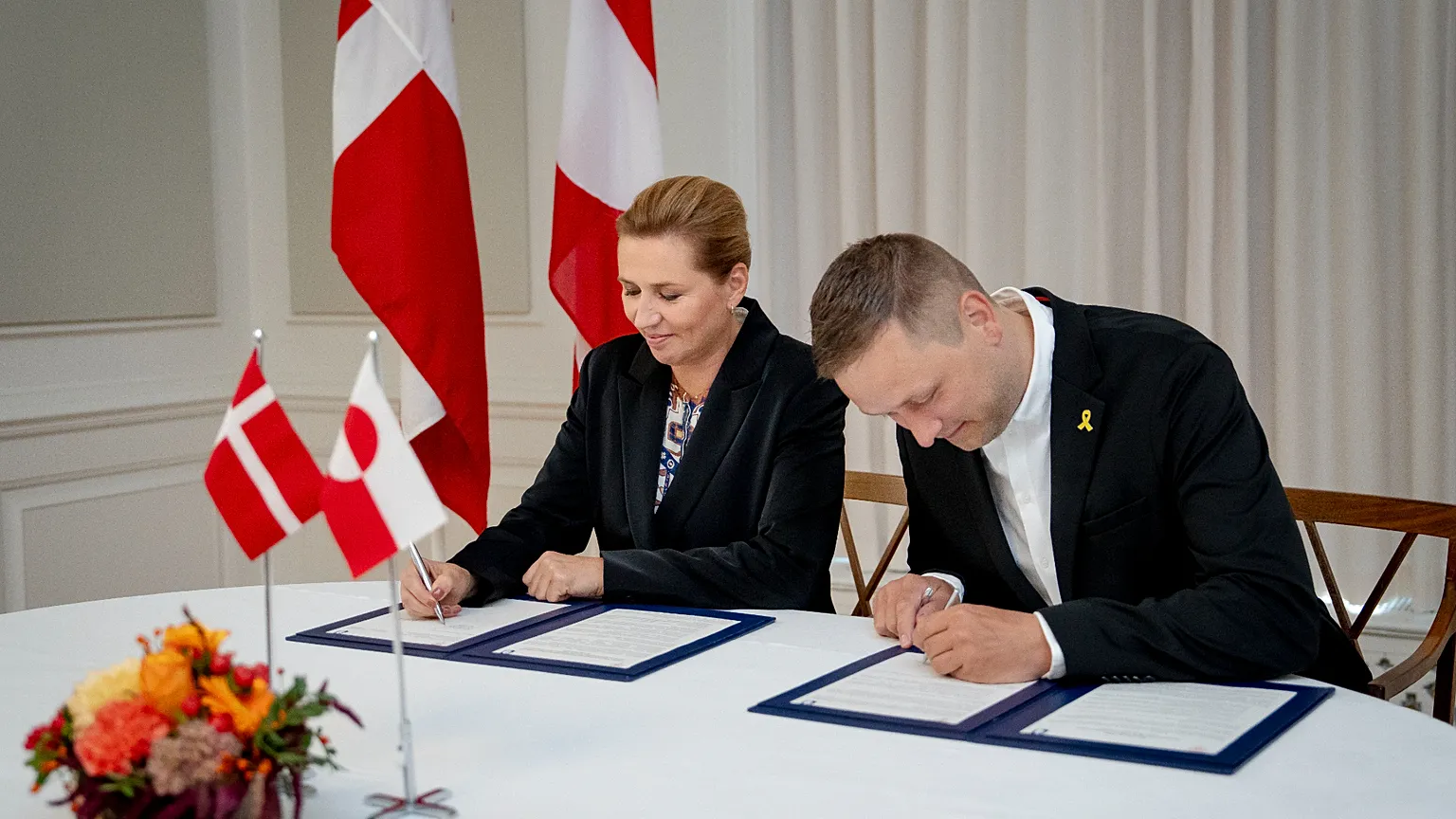
Two days later, Donald Trump, Danish Prime Minister Mette Frederiksen and Greenlandic Prime Minister Jens-Frederik Nielsen signed an Arctic security agreement in New York. The juxtaposition was revealing. Washington could still obtain extensive, durable security access through negotiation, while Denmark and Greenland preserved explicit language on sovereignty and self-determination. The week did not establish a European-Canadian bloc. It showed why Ottawa and European capitals increasingly want additional institutions before the next crisis forces improvised coordination.
Davos supplied the doctrine; tariffs supplied the pressure; Strasbourg supplied the label.
Four Claims That Need a Reality Check
First, Europe and Canada are not rushing to conclude a new free-trade agreement. They already have CETA, which has applied provisionally since September 21, 2017. The more accurate formulation is that both sides want to move beyond CETA while securing its full ratification. Seventeen EU states have completed national ratification; Belgium, Bulgaria, Cyprus, France, Greece, Hungary, Ireland, Italy, Poland and Slovenia have not. Most commercial provisions operate, but investment protection and the Investment Court System await full ratification.
Second, Canada’s dependence on the United States varies significantly by category. The share of merchandise exports going south fell from 75.9% in 2024 to 71.7% in 2025. Global Affairs Canada rounds the latter to 72%. Services are less concentrated: the United States received 53% of Canadian services exports in 2025. Re-exports were more exposed, with 80.1% going to the United States. Assertions that “75% of Canadian exports” go to the US therefore require a category and a year; they cannot safely be applied to all exports.
Third, the EU–US tariff arrangement is not a universal exchange of zero European tariffs for a flat 15% US tariff. The US commitment is generally an all-inclusive ceiling of 15% on covered EU goods, with most-favoured-nation treatment for specified products and distinct treatment for steel, aluminium and derivatives. The EU has removed remaining duties on many US industrial goods and granted quotas or reduced rates for some agricultural and seafood products. Its implementing regulations include safeguards, suspension powers and sunset clauses. The arrangement is asymmetric, but the popular shorthand erases its exceptions and enforcement machinery.
Fourth, Trump’s language about obtaining permanent or complete security control over Greenland must be separated from the signed agreement. The text supplements the 1951 defence framework, has no end date, provides durable US military and security privileges and establishes restrictions and consultation around adversarial investment. Yet it expressly recognises the sovereignty and territorial integrity of the Kingdom of Denmark and Greenlanders’ right to self-determination. It enters into force only after the necessary Danish and Greenlandic parliamentary procedures.
One further numerical claim remains unsettled. At the September 18 briefing, a Commission spokesman said goods trade had risen by more than 75% and services trade by 97% during CETA’s provisional application. The latest Council summary based on Eurostat reports growth from 2016 to 2025 of more than 76% for goods and around 90% for services. Different extraction dates or series may explain the services gap, but a public reconciliation was not available. The defensible publication figure is the documented Eurostat summary, with the 97% statement identified as an unreconciled official claim.
Every dependence figure needs a category, a year and a denominator.
| Share sent to the United States (%) | |
|---|---|
| 2024 merchandise exports | 75.9 |
| 2025 merchandise exports | 71.7 |
| 2025 services exports | 53 |
From CETA to an Alliance for the Future
The relationship already resembles a layered association even though it lacks that name. CETA governs much of trade and procurement. The Strategic Partnership Agreement provides political dialogues across foreign policy, security, climate, energy and justice. Canada has participated in Pillar II of Horizon Europe since 2024. A 2025 security and defence partnership placed multiple activities under a common political framework. In 2026, Canada became the first non-European country admitted to procurement supported by the EU’s SAFE defence instrument.
These arrangements matter because they narrow the distance between rhetoric and capacity. Canadian researchers can join eligible Horizon consortia and participate in programme governance under the association agreement. Canadian defence companies and products can enter qualifying SAFE-backed joint procurement, although only EU member states receive SAFE loans. CETA provides extensive access to government procurement and committees covering regulation, services, raw materials and sustainable development. Association would therefore begin from an operating base rather than a blank page.
EU law also offers a plausible legal route without accession. Article 217 of the Treaty on the Functioning of the European Union permits agreements with third countries that establish reciprocal rights and obligations, common action and special procedures. Association agreements vary widely: some support eventual accession, while others organise durable relationships with countries that will remain outside the Union. The provision is flexible enough to warrant examination, but flexibility is not the same as legal certainty. The content of the Canadian project will determine its legal basis and ratification requirements.
A comprehensive agreement spanning trade, defence, mobility, research, energy and financial regulation could cross areas of both EU and member-state competence. That raises the possibility of a mixed agreement requiring national ratification—the same political vulnerability that has kept CETA incomplete. A narrower EU-only instrument could move faster but cover less. A third route would package several sectoral agreements beneath a political umbrella, producing practical integration without creating a single constitutional status. As of September 27, the Commission had not selected among these options.
The governance questions are equally consequential. Canada would need to know whether it could help shape rules or merely adopt them for access. The EU would need mechanisms to monitor compliance, suspend benefits and settle disputes. Deeper market privileges could require budget contributions, regulatory equivalence, data-protection commitments, state-aid disciplines or acceptance of decisions influenced by the Court of Justice. Mobility would raise questions of labour law, social security, professional recognition and member-state competence. None can be answered by the word “associate.”
The most realistic early outcome is therefore not a miniature membership package. It is a governed economic-security space: a council or joint committee at leaders’ or ministerial level; sectoral boards for defence, minerals, energy and technology; defined financial contributions to selected programmes; and dispute procedures linked to each instrument. Such an architecture could be politically branded as associate membership while remaining legally a collection of external agreements. The label would be novel; the instruments would draw on familiar EU practice.
The label can be unprecedented even if the legal instruments are familiar.
| EU member states | |
|---|---|
| Ratification completed | 17 |
| Ratification outstanding | 10 |
The Capabilities Bargain
The case for deeper association rests on complementarity rather than cultural affinity alone. The European Union offers a market of roughly 450 million people, manufacturing scale, research networks, regulatory reach and growing defence procurement demand. Canada offers energy, minerals, Arctic geography, capital, a sophisticated financial sector and recognised strengths in artificial intelligence, quantum research and space. The political proposition is that each side possesses assets the other needs to reduce strategic dependence.
Critical minerals provide the clearest developing bargain. The EU and Canada established a raw-materials partnership in 2021, with work on value-chain integration, research, investment and environmental standards. In March 2026, their responsible ministers reaffirmed the partnership and highlighted an investment signal from the European Investment Bank. Canada has begun financing extraction and processing, including a potential C$850 million expansion at the Trail smelting and refining complex. Europe, meanwhile, is building project-finance, joint-purchasing and stockpiling tools. What remains missing is a published EU–Canada portfolio of named mines, processing plants, offtake volumes and delivery dates.
Defence is the most operational exchange. SAFE creates a route for Canadian companies to participate in EU-backed common procurement, and the first contract involving a Canadian company had been announced by June. Canada gains access to aggregated European demand; Europe gains another trusted industrial base and potential capacity in areas including sensors, vehicles, aerospace and space systems. But participation is not integration. Rules of origin, intellectual property, security clearances, export controls and the allocation of production will determine whether procurement builds shared capacity or merely reallocates orders.
Energy is more uneven. Canada can expand crude oil, natural gas, uranium, hydrogen and clean-energy technology exports, while Europe can supply equipment, capital and expertise in grids, offshore wind, nuclear technology and decarbonisation. A June business roundtable connected Canadian LNG projects with potential European buyers. Yet Carney’s proposal for LNG and hydrogen “at large scale” depends on terminals, pipelines, port infrastructure, financing, permits and long-term contracts. Energy cooperation is strategically plausible but operates on infrastructure timescales, not summit timescales.
Research and advanced technology sit between operational and aspirational. Horizon Europe already supports collaboration, and both sides have established dialogues on digital policy, cybersecurity, artificial intelligence and quantum technology. Shared AI safety protocols and research programmes could advance relatively quickly. Joint sovereign computing capacity, secure trans-Arctic broadband links and a coordinated industrial strategy require much larger commitments: data-centre sites, power supply, semiconductor access, public procurement and rules governing sensitive data and intellectual property.
Space cooperation also has a concrete starting point. In Saint-Pierre-et-Miquelon, Carney and Macron directed their space agencies, defence ministries and industries to develop and share infrastructure, including launch and ground-control systems. Canada’s geography could support Arctic observation and communications; European programmes offer scale and technical depth. But the direction to agencies is an agenda, not yet a funded programme. The October summit will need to identify projects, sponsors and budgets if space is to become more than a symbol of high-technology alignment.
Financial services and payments are the most institutionally ambitious proposals. Canadian banks and pension funds could add capital and resilience; European payments and market infrastructure could help diversify channels now dominated by US systems. An integrated market, however, would require work on prudential supervision, resolution, deposit protection, consumer rules, data access, securities regulation and recognition of provincial Canadian jurisdictions. Limited cooperation on payments interoperability or investment mobilisation is feasible. A seamless transatlantic financial market is not close.
Trade growth provides scale but requires careful presentation. Eurostat-based Council figures put two-way EU–Canada trade in goods and services at €130.8 billion in 2025. Goods trade rose from roughly €46 billion in 2016 to €81.8 billion in 2025; services rose from about €25.6 billion to €49.1 billion. These are nominal values influenced by prices, exchange rates and post-pandemic effects. They establish that the commercial relationship has expanded substantially. They do not prove that political association will overcome geography, logistics or US market gravity.
The agenda is concrete; delivery horizons range from months to decades.
| Two-way trade (€bn) | |
|---|---|
| Goods, 2016 | 46 |
| Goods, 2025 | 81.8 |
| Services, 2016 | 25.6 |
| Services, 2025 | 49.1 |

Trump Is the Accelerant, Not the Architect
Trump’s role is direct but bounded. Tariffs raised the cost of Canadian dependence and demonstrated that a dense North American trading relationship could be used coercively. Repeated comments about Canada and Greenland, together with provocative maps, unsettled assumptions about borders and alliance restraint. European governments faced their own tariff bargain with Washington and continuing doubts about US security commitments. These shocks made resilience, diversification and sovereignty politically urgent on both sides of the Atlantic.
They did not create the relationship’s foundations. CETA was negotiated years earlier and provisionally applied from 2017. The raw-materials partnership dates to 2021. Canada joined part of Horizon Europe in 2024. The EU and Canada launched a strategic partnership of the future and signed a security and defence partnership in June 2025. Negotiations for Canadian participation in SAFE preceded the Strasbourg proposal. The institutional line is therefore one of acceleration and consolidation, not sudden invention.
The comparison between Carney’s retaliation and Europe’s accommodation also needs discipline. Canada imposed matched counter-tariffs after rejecting US terms; the EU accepted an arrangement that removes many European duties while generally capping US tariffs on covered EU goods at 15%. That difference reflects political choice, but also different economies, legal competences and exposure. The EU negotiates for 27 states and must manage internal sectoral interests. Canada trades much more intensively with the United States and can apply national countermeasures, but bears a proportionally larger risk from prolonged escalation.
The Greenland agreement illustrates the ambiguity. Trump’s pressure helped produce an accord granting Washington durable military and security advantages. Yet the final text reaffirmed Danish sovereignty and Greenlandic self-determination, embedded cooperation in the NATO context and required parliamentary procedures. Coercive rhetoric may have altered bargaining conditions without achieving annexation. For Europe and Canada, the lesson is not simply that resistance succeeds or accommodation fails. It is that allies need enough collective capacity to prevent one bilateral negotiation from defining the strategic environment for everyone else.
Leaders insist that the emerging partnership is for resilience rather than against the United States. That is a proposition, not yet a settled fact. Many planned capabilities—defence, Arctic surveillance, energy and technology—would reinforce NATO and could benefit the wider transatlantic system. At the same time, their purpose is explicitly to reduce vulnerability to unilateral US pressure. The project can be complementary to America in normal conditions and an insurance policy against America under coercive conditions. Its significance lies in trying to make both functions possible.
The project is simultaneously a reinforcement of the Atlantic system and insurance against its dominant power.
Why the Common Front May Remain Shallow
The economic constraint begins with geography. Diversification improved in 2025, but nearly 72% of Canadian goods exports still went to the United States. Energy systems, automotive production, railways, pipelines and supplier networks are structured around the continental market. European demand can support selected minerals, energy products, aerospace, services and technology, but it cannot quickly reproduce the scale, proximity and infrastructure of US trade. A fall in the US share can also reflect weaker exports rather than successful replacement.
Europe’s constraint is security dependence. EU defence investment and industrial policy are expanding, and SAFE may strengthen production. Yet NATO remains the central collective-defence structure, with the United States providing capabilities Europe cannot rapidly replace across intelligence, strategic lift, missile defence, nuclear deterrence and high-end logistics. Canada is itself deeply integrated into North American defence through NORAD. An EU–Canada security space can add resilience without creating strategic separation from Washington.
Institutional politics could be equally limiting. Ten national ratifications of CETA remain unfinished despite nearly nine years of provisional application and substantial trade growth. Agriculture, procurement, investment arbitration, data, financial regulation and labour mobility can activate protected interests in both Europe and Canada. Provinces hold important Canadian powers; EU member states guard authority over taxation, social security and parts of migration policy. Extending selected benefits without the full obligations of membership will invite demands for safeguards and reciprocity.
The shallow-front interpretation is therefore plausible: Ottawa may be using Europe to gain leverage and alternative options in negotiations with Washington, while Brussels gains a powerful symbol of autonomy without accepting the cost of a break with the United States. Both can celebrate association while choosing low-cost cooperation in research, dialogues and procurement. The test is whether they proceed when integration requires budget contributions, infrastructure spending, regulatory concessions or politically difficult market access.
This countercase does not negate the partnership. It identifies the threshold between diplomatic alignment and strategic autonomy. A coalition capable of issuing joint statements already exists. A coalition capable of absorbing retaliation, financing redundant infrastructure and sustaining defence production is much harder to build. If Europe and Canada avoid those costs, their common front will remain useful but shallow: a diversification mechanism inside the US-led Atlantic system, not an independent pole.
The alliance becomes strategic only when governments accept the cost of redundancy.
| Share or completion rate (%) | |
|---|---|
| Canadian goods exports to US | 72 |
| Canadian services exports to US | 53 |
| EU states completing CETA ratification | 63 |
The October Proof Test
The first decisive checkpoint will arrive on October 29 and 30 in Montreal. The summit occurs only six weeks after the associate-member proposal, too soon for a comprehensive treaty. It is not too soon for a negotiating structure. The minimum credible result would be a joint instruction to officials defining the project’s scope, legal options, workstreams and deadline. A declaration that merely repeats the phrase “alliance for the future” would preserve momentum but add little institutional substance.
The legal test is whether leaders identify a route. They could commission an Article 217 association agreement, direct negotiations on a mixed or EU-only treaty, or establish a political umbrella over specified sectoral agreements. Any option should state who negotiates, which institutions approve the outcome and how national and parliamentary scrutiny will operate. Silence on the legal vehicle would indicate that “associate membership” remains branding rather than a status under construction.
The material test is a list of funded deliverables. That could include named critical-mineral projects and offtake arrangements; SAFE procurement packages; an energy infrastructure and contracting roadmap; Canadian participation in Erasmus+ or the next EU research framework; a sovereign-computing pilot; shared Arctic or space infrastructure; or a payments-interoperability project. Each requires a lead institution, financing source, regulatory pathway and delivery date. Announcing more dialogues without projects would not meet the standard set in Strasbourg.
CETA supplies another measurable test. A summit cannot compel ten national parliaments to ratify, but it can publish a state-by-state plan, identify the unresolved objections and clarify which provisions remain outside provisional application. Movement by even one or two holdout states would strengthen the case that deeper association can overcome existing institutional blockages. No movement would underline the risk of constructing a more ambitious relationship on an agreement Europe has not completed.
The bounded verdict is therefore conditional. If Montreal produces a legal route, governing bodies, money and initial projects, associate membership may become a replicable model for middle powers seeking deep alignment without accession. If it produces only another declaration, the Strasbourg moment will remain an exceptionally ambitious metaphor. Europe and Canada already share roots across trade, security, research and political values. The question is whether that transatlantic forest can grow institutions strong enough to withstand pressure.
Montreal must supply a route, machinery, money and delivery dates.
| Proof threshold | |
|---|---|
| Minimum: negotiating mandate | 1 |
| Substantive: funded projects | 2 |
| Transformative: legal route and governance | 3 |
- The report distinguishes binding texts, operative government measures and official statistics from political speeches, proposals and press-briefing language.
- Claims about “associate membership” were checked against the Treaty on European Union, the Treaty on the Functioning of the European Union and the Commission’s September 18, 2026 briefing. No definitive legal route had been announced by September 27, 2026.
- Trade dependence was separated by category. Merchandise exports, services exports, re-exports and combined trade were not treated as interchangeable measures.
- CETA growth figures were compared across official Eurostat, Council, Commission and Canadian summaries. Where published official figures diverge, the report states the discrepancy rather than selecting the most favourable number.
- Tariff claims were checked against operative Canadian product lists and EU regulations. Headline rates were distinguished from ceilings, most-favoured-nation treatment, quotas, safeguards, suspensions and product-specific exceptions.
- The Greenland section relies on the signed September 22 agreement and official Danish, Greenlandic and US descriptions. Political claims of “control” are distinguished from provisions on sovereignty, basing, investment screening and entry into force.
- Capability proposals were graded implicitly by maturity: operational where an agreement or procurement channel exists; developing where official work programmes or investments exist; and aspirational where leaders have proposed an outcome without funding, governance or a delivery calendar.
- The forecast is bounded to observable outcomes at the October 29–30 summit in Montreal. It does not assume that a political declaration will become enforceable policy.
- European Commission · 2026 State of the Union Address by President Ursula von der Leyen · 2026-09-16
- Prime Minister of Canada · Prime Minister Carney delivers an address to the European Parliament · 2026-09-17
- European Commission Audiovisual Service · Midday press briefing: EU–Canada relations and associate membership · 2026-09-18
- Prime Minister of Canada · Prime Minister Carney delivers remarks at the World Economic Forum Annual Meeting · 2026-01-20
- Prime Minister of Canada · Statement by Prime Minister Carney on Canada–US trade negotiations · 2026-08-21
- Department of Finance Canada · Complete list of US products subject to counter-tariffs · 2026-08-26
- Statistics Canada · Canadian international merchandise trade, December 2025 · 2026-02-19
- Global Affairs Canada · State of Trade 2026: The rise of services in Canada’s trade landscape · 2026-08
- European Commission · EU–Canada agreements and CETA ratification status · 2026-09
- Council of the European Union · EU–Canada trade: facts and figures · 2026-06
- EUR-Lex · Article 49 of the Treaty on European Union · 2016-06-07
- EUR-Lex · Article 217 of the Treaty on the Functioning of the European Union · 2016-06-07
- Council of the European Union · SAFE: Council concludes agreement with Canada · 2026-06-15
- European Commission Directorate-General for Research and Innovation · Second Horizon Europe association Joint Committee meeting between Canada and the EU · 2026-04-07
- Natural Resources Canada · Joint statement on EU–Canada critical raw-materials cooperation · 2026-03-02
- Prime Minister of Canada · Prime Minister Carney meets with President Emmanuel Macron · 2026-09-20
- Prime Minister’s Office of Denmark · Agreement between Greenland, Denmark and the United States · 2026-09-22
- The White House · Agreement between the United States, Denmark and Greenland amending the Greenland defence framework · 2026-09-22
- European Commission Directorate-General for Trade and Economic Security · Joint statement on a United States–European Union trade framework · 2025-08-21
- Council of the European Union · EU–US trade: agreement to implement the tariff elements of the joint statement · 2026-05-20
- Council of the European Union · EU–Canada summit, 29–30 October 2026 · 2026-09-21
- Associated Press · Trump’s map-making on social media stirs controversy in the North Atlantic · 2026-09-08